
How do you know an HVAC system has crossed the line where repairs stop making sense? In Holland, MI, the warning signs usually show up together: a compressor pulling more amps every summer, a heat exchanger flagged during the last inspection, repeated refrigerant top-offs on an R-22 or early R-410A system, and utility bills rising while comfort drops. Our test is straightforward. If a repair costs a meaningful share of a replacement and the equipment is past twelve to fifteen years, the fix is likely to buy months rather than years, and the money goes into technology a generation behind today's SEER2 and AFUE standards.
The repairs homeowners call us about most are AC Repair and Furnace Repair. If something has stopped working, start there.
Warning Signs for HVAC Replacement
Catching these issues early helps you avoid costly problems. Keep an eye out for the following clues:
- Higher energy bills year after year with no obvious explanation
- Repair bills stacking up faster, each larger than the one before
- An aging system, twelve to fifteen years or more, with problems piling up
- An R-22 system, or one that loses refrigerant faster than recharges can justify
- A system so noisy you hear every start and stop
- A compressor or heat exchanger failure, the two repairs that change the math
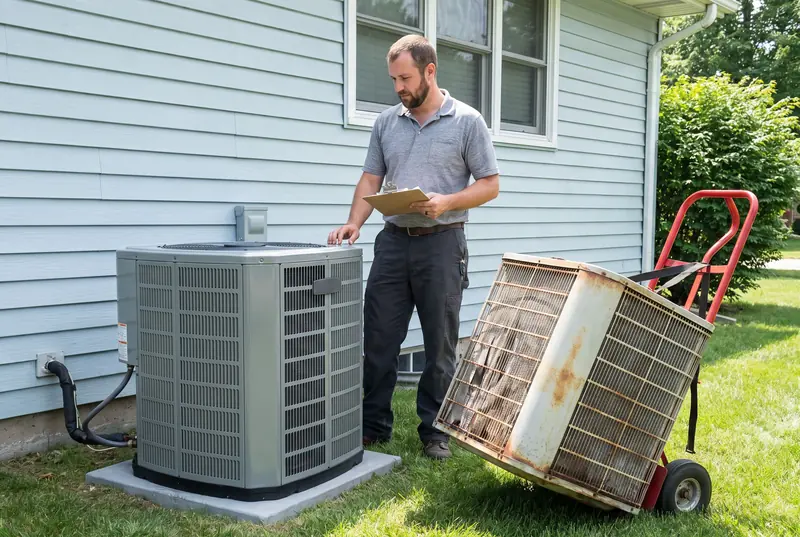
- Visible rust, soot, or corrosion spreading on the cabinet or coils
- Persistent comfort problems that no repair has solved
Act Before It Gets Worse
What seems like a minor issue today can take out a compressor or heat exchanger tomorrow. If you notice any of these signs, call (616) 207-6305 for a prompt inspection.